Mechanisms
Mechanisms are electron bookkeeping. If you can track electrons, you can predict products. This page focuses on the core “moves” and how to choose pathways.
Arrow pushing: rules that prevent mistakes
| Rule | What it prevents |
|---|---|
| Arrows start at electron density (lone pair, bond, negative charge) | impossible arrows from “nowhere” |
| Second-row atoms obey octet (C, N, O, F) | pentavalent carbon errors |
| Check formal charge before/after each step | silent charge imbalance |
| Acid/base steps are common and fast | missing proton transfers |
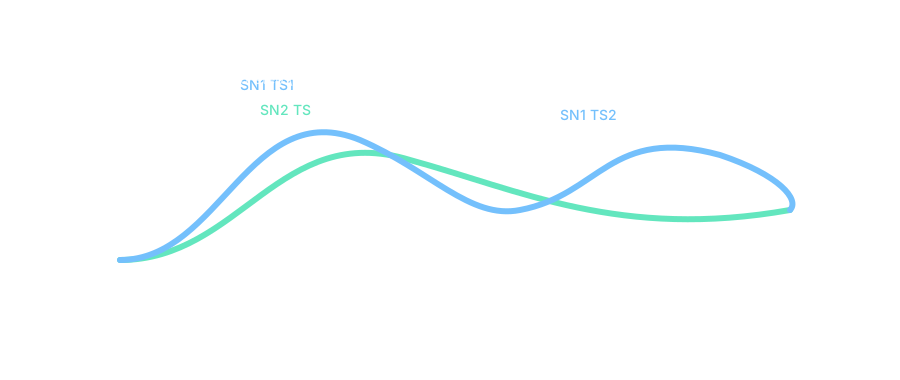
SN1 vs SN2 decision chart
Substitution depends on substrate, nucleophile strength, solvent, and leaving group. Use the table as a rapid classifier.
| Feature | SN2 | SN1 |
|---|---|---|
| Substrate | methyl, 1° (sometimes 2°) | 3° (sometimes 2°), allylic/benzylic |
| Rate law | rate ∝ [RX][Nu⁻] | rate ∝ [RX] |
| Stereo | inversion | racemization (often partial) |
| Solvent | polar aprotic | polar protic |
| Rearrangements | no | possible (carbocation shifts) |
E1 vs E2 highlights
| Feature | E2 | E1 |
|---|---|---|
| Base | strong base required | weak base OK |
| Mechanism | one-step, concerted | two-step via carbocation |
| Geometry | anti-periplanar β-H and leaving group | not geometric-constrained (after ionization) |
| Regioselectivity | Zaitsev usually; bulky base → Hofmann | Zaitsev (thermodynamic) |
Common trap: strong nucleophile can also be strong base. Decide by substrate sterics and temperature.